
Ayub Ahmed
- Solicitor

Most people, when asked, would be able to provide a basic description of a construction contract. An answer might be along the lines of ‘a legally binding agreement for carrying out construction work’. The question might inspire images of a homeowner who contracts with a contractor for the construction of a conservatory or an extension.
While technically correct, on a pure reading of the language, those who operate in the construction industry will know that there are some subtle differences between a ‘construction contract’, in the everyday meaning of the words, and a construction contract (that is governed by the terms of the Housing Grants, Construction and Regeneration Act 1996 (commonly known as the Construction Act 1996)).
A construction contract can take any form – they can be industry standard forms (such as NEC, SBCC, JCT, FIDIC, etc) or bespoke. Whatever form, the Construction Act 1996 defines a construction contract as a contract for carrying out, arranging for carrying out, or providing labour for carrying out “construction operations”. These can include contracts with architects, designers and surveyors.
Construction operations are also defined in the 1996 Act. This includes construction, demolition, repair, alteration, maintenance, installation (and more) upon structures, land, roads, general infrastructure (and more).
There are exceptions to what is considered a construction contract under the 1996 Act. These include contracts for drilling or extracting oil, gas or minerals; delivering materials, plant and machinery to a building site (unless that contract calls for those to be installed also), among other things. A notable exception concerns contracts with a residential occupier, which provides the 1996 Act does not apply to construction contracts with ‘residential occupiers’ (i.e. construction contracts for works done to an individual’s home).
Isn’t it ironic that one of the most likely examples to come to mind when a lay person thinks of a ‘construction contract’, as noted above, is not actually a ‘construction contract’ in terms of the 1996 Act?
Taking the above into account, here are some practical examples:
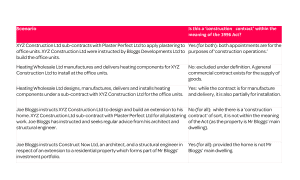
Why is it important to identify whether you are party to a construction contract within the meaning of the 1996 Act? The answer lies within two of the most common issues in the industry: payments and disputes.
The 1996 Act introduced statutory rights applicable to construction contracts (as defined in the Act). It gives a party the right to receive staged payments – a vital way to maintain cashflow for contractors, sub-contractors and consultants to keep a project moving. Failure to comply with the payment provisions of the 1996 Act can result in parties being liable to pay sums which they might otherwise dispute are due.
It also gives the right, exercisable by any party under a construction contract, to refer a dispute to ‘adjudication’. Adjudication is a fast-track form of alternative dispute resolution designed to reach a decision much more quickly than a court, again, this is to keep a project in motion and cash flow protected. Where the parties fall into dispute under their construction contract, an adjudicator (usually an individual with specialist knowledge of construction projects and construction law) will hear the dispute from each party’s perspective and reach a decision within 28 days (subject to agreed extensions) from the date the dispute was referred to adjudication.
Adjudication decisions are binding on an interim basis. It must therefore be complied with immediately and can only be challenged later, on narrow grounds. In simple terms, a decision under adjudication imposes a ‘pay now, argue later’ approach.
Parties to contracts which are governed by the provisions of the act should take advice on any issues arising from payment or any potential disputes as early as possible.
Our specialist Contentious Construction team regularly advise on disputes and potential issues arising under construction contracts to help clients uphold their legal and commercial position in ongoing or concluded projects.
Our key strengths are our first-class legal expertise, our commercial awareness, and our ability to provide fast, comprehensive and easy-to-understand advice.
We understand the difficulties and opportunities facing construction and engineering businesses and are here to advise on rights and obligations, and to provide effective representation when disputes arise.
If you have any queries relating to construction contracts or any other issue mentioned in this article, please contact Ayub Ahmed or a member of our Contentious Construction team.